Flooding can turn a secure property into an immediate health, safety and financial risk within hours, and knowing how to choose an effective emergency flood restoration service is essential for homeowners and businesses in Sydney. This article explains what emergency flood restoration involves, why speed and correct technique matter, and how to evaluate providers so you can limit damage, protect occupants and speed up recovery. You will learn the timeline of damage escalation, the core restoration services to expect, the credentials and equipment that matter, and how professional teams support insurance claims in Australia. Practical checklists, comparison tables and quick-action lists are included to help you make decisions under pressure, and the guidance highlights the capabilities a reputable provider should offer. Throughout the guide we use plain language and industry terms such as water extraction services, structural drying services and mould remediation services so you can recognise technical scopes during an emergency. The next section explains why immediate action matters, followed by a decision checklist for choosing a flood damage repair company, a breakdown of core restoration services, insurance claim assistance, and prevention and preparedness measures for future resilience.
Why Is Immediate Emergency Flood Restoration Critical?
Immediate emergency flood restoration is the process of quickly assessing and stabilising water-damaged property to prevent secondary damage, health hazards and escalating repair costs. Acting fast removes standing water, limits moisture penetration into building fabric, and reduces the window for mould colonisation and structural failure. Rapid response preserves materials that are salvageable, cuts the time and cost of reconstruction, and reduces business interruption for commercial premises. Early professional intervention also documents conditions and exposure, which supports insurance assessment and a more accurate scope of repair. Understanding these benefits clarifies why timing matters and what to expect from an initial response.
When a flood team arrives promptly they start with containment, safety checks and a priority water-extraction plan to protect occupants and critical systems. This leads directly into the detailed risks that arise if restoration is delayed and the specific actions a 24/7 team will take on arrival.
- Immediate restoration actions that matter:Remove standing water and isolate contaminated zones to protect health.Deploy drying equipment and moisture mapping to prevent mould growth.Document conditions with photos and moisture logs for insurance purposes.
These rapid steps are the difference between limited repairs and full-scale reconstruction, and they set up the next phase: detailed mitigation and drying.
What Are the Risks of Delayed Water Damage Restoration?
Delayed water damage restoration dramatically increases the likelihood of mould growth, structural degradation and electrical hazards, with measurable timelines that escalate risk within hours and days. Mould spores can begin to colonise damp porous materials within 24–48 hours, compromising indoor air quality and posing respiratory hazards for occupants. Continued moisture weakens timber, plaster and adhesives, causing warping, delamination and the need for more extensive repair or replacement. Electrical systems and appliances exposed to floodwater can create fire and shock risks if not isolated and inspected promptly. Recognising these timelines helps property owners prioritise fast, professional intervention to limit health risks and long-term costs.
Preventing these outcomes depends on immediate containment and documented drying plans, which leads into how a 24/7 flood restoration response specifically reduces these risks through swift, standardised actions.
How Does Rapid 24/7 Flood Restoration Minimise Property Damage?
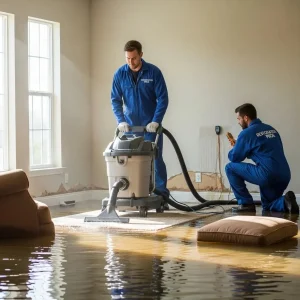
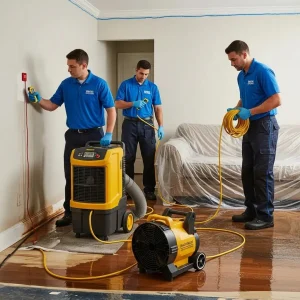
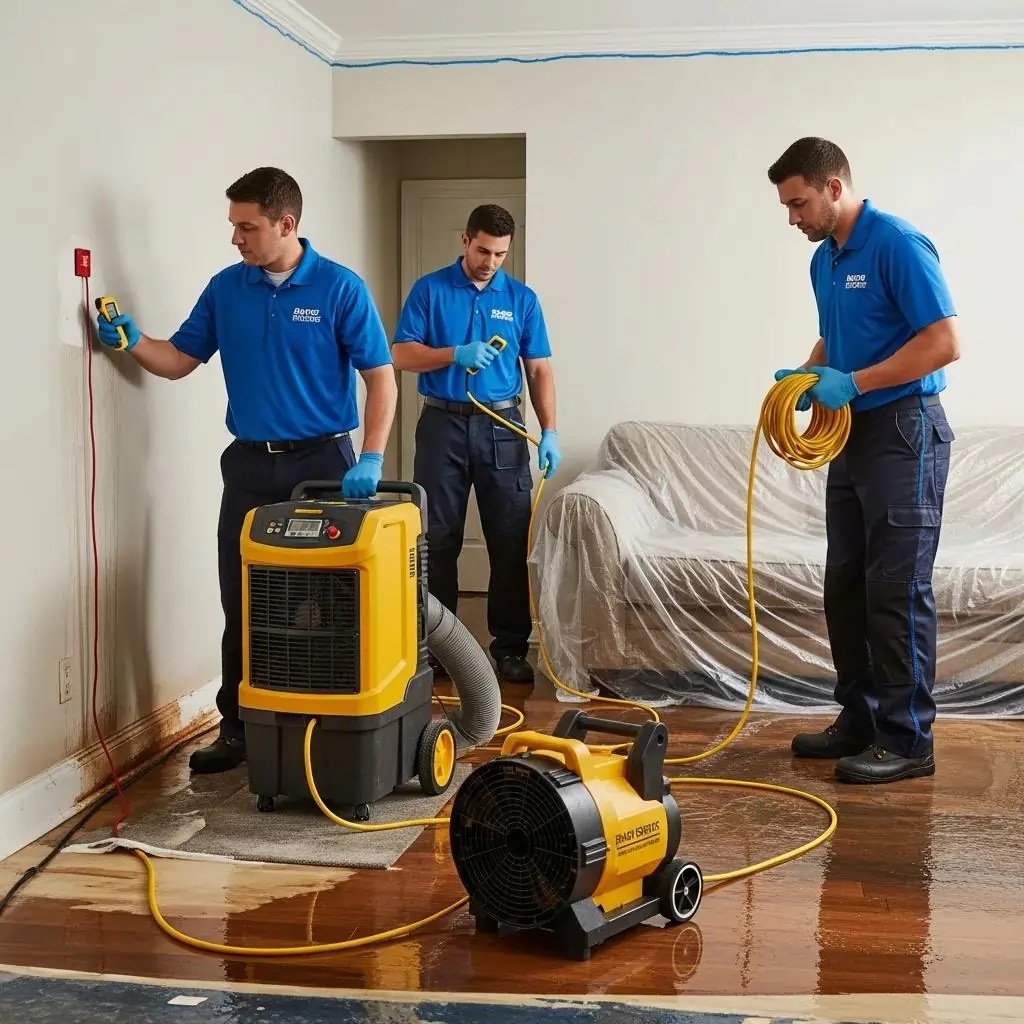
A rapid 24/7 flood restoration response minimises property damage by shortening the time water remains in contact with building materials and by initiating controlled drying strategies immediately. On arrival, technicians perform a safety and contamination assessment, isolate utilities, and start high-capacity water extraction to remove standing water quickly. They then set up directed airflow with industrial fans and dehumidifiers alongside moisture mapping to monitor progress, which preserves materials and prevents hidden moisture pockets. The continuous availability of emergency teams shortens the response window and reduces the escalation from repairable damage to full rebuilds. These practical outcomes demonstrate why response time and proven drying protocols are core criteria when choosing a provider.
Quick mitigation creates measurable reductions in repair scope and cost, which naturally leads to the checklist of provider qualifications you should prioritise when hiring a flood damage repair company.
What Key Factors Should You Consider When Choosing a Flood Damage Repair Company?
Choosing the right flood damage repair company requires evaluating credentials, response time, service range, equipment, local reputation and insurance support to ensure predictable outcomes. Look for providers that can demonstrate standardised training, thorough documentation practices, and immediate availability for 24 hour emergency flood cleanup. The right mix of advanced equipment, technician expertise and local knowledge improves drying accuracy and reduces the chance of lingering moisture and mould. Customer reviews and local references provide practical evidence of reliable turnaround and transparent pricing. Considering these factors together helps you select a team that will protect your property and streamline communication with insurers.
Important decision factors include the following checklist to use when contacting providers:
- Response and availability: Confirm they offer 24/7 emergency response and same-day mobilisation.
- Credentials and training: Ask about industry certification, technician training and safety standards.
- Range of services: Ensure they provide water extraction, structural drying, mould remediation and sanitisation.
- Equipment and diagnostic tools: Verify use of moisture meters, thermal imaging and industrial drying gear.
- Insurance support: Confirm they provide photographic reports, moisture logs and itemised quotes for claims.
This checklist prepares you to ask targeted questions, and the next table compares why each credential or feature matters when assessing providers.
Why Is IICRC Certification Important for Flood Restoration Services?
IICRC certification denotes adherence to recognised industry standards for cleaning, drying and restoration, and it indicates that technicians receive formal training on proven procedures. Certified companies and technicians follow established protocols for moisture mapping, drying goals and contamination control, which reduces variability in outcomes and improves safety. This standardisation helps ensure that drying targets are documented, equipment is used correctly, and health risks are managed consistently. Asking providers about IICRC-aligned procedures gives you confidence that the work will follow accepted methodologies rather than ad hoc approaches. Understanding certification helps you prioritise service quality over lowest-cost options when selecting a contractor.
Certification is one sign of competence, but practical experience and local reputation are equally important in predicting reliable performance during a flood event.How Does Experience and Local Reputation Influence Service Quality?
Experience and local reputation influence service quality because teams familiar with regional flood patterns, common construction types and local logistics can respond more effectively and anticipate challenges. Local providers with demonstrable case studies or repeat business tend to have refined processes for fast mobilisation, permit navigation and supply sourcing. Requesting references, before-and-after examples or documented project summaries helps verify that claims of capability translate into real-world results. For example, some providers advertise decades of local experience combined with 24/7 response and IICRC-certified technicians, which signals both institutional knowledge and standardised practice. Checking reputation alongside credentials gives a fuller picture of likely performance during an emergency.
A provider’s documented experience often correlates with efficient workflows and better coordination with insurers, which is important when moving from mitigation to claims and repairs.
These attributes help you prioritise firms that combine technical competence with reliable local delivery, and the next section describes the comprehensive service components a professional restoration team should include.
Which Comprehensive Services Should a Professional Emergency Flood Restoration Include?
A comprehensive emergency flood restoration offering includes emergency assessment, water extraction services, structural drying services, mould remediation services, sanitisation and coordination for repairs and reconstruction. Full-service teams provide a single point of responsibility from initial mitigation through handover, which reduces delays and avoids fragmented scopes between contractors. Diagnostic services such as moisture mapping and thermal imaging ensure drying is complete before repairs proceed, preventing hidden moisture that can cause later failures. Cleaning, deodorising and targeted reconstruction coordination finish the restoration so occupants can safely return. Knowing these service components lets you compare quotes based on scope rather than price alone.
Core restoration services typically include the following:
- Emergency assessment and safety: Rapid triage, isolation of hazards and contamination classification.
- Water extraction services: High-capacity pumps and wet vacs to remove standing water quickly.
- Structural drying and moisture mapping: Directed airflow, dehumidifiers and monitoring until dry.
- Mould remediation and sterilisation services: Containment, removal and sanitisation to restore healthy environments.
- Cleaning and reconstruction coordination: Deodorising, repair scoping and liaison with trades.
What Are the Steps in Water Extraction, Structural Drying, and Mould Remediation?
The restoration process follows a clear sequence: initial assessment and containment, water extraction, targeted drying with continuous monitoring, mould assessment and remediation if needed, and final verification and handover. First, technicians prioritise safety, isolate utilities and document conditions to support insurance. Next, they use pumps and extraction equipment to remove bulk water, followed by strategic placement of dehumidifiers and fans guided by moisture meters and thermal imaging. If mould risk is confirmed, containment and remediation steps occur alongside drying to prevent cross-contamination. Final verification includes moisture readings, photographic evidence and a sign-off that drying goals have been achieved before repairs begin.
Research into effective mould remediation methods continues to evaluate the efficiency of various treatments for contaminated building materials.
Mold Remediation: Evaluating Building Material Treatments
We compared the efficiency of some commercially available products and methods used for remediation of mould-contaminated building materials. Samples of gypsumboard and pinewood were artificially contaminated with toxin-producing isolates of Stachybotrys chartarum and Aspergillus versicolor, respectively, then, ten different remediation treatments were applied according to the manufacturers’ instructions.
Remediation of mould damaged building materials efficiency of a broad spectrum of treatments, R Haase, 2012
This stepwise approach reduces rework and ensures restoration follows measurable goals rather than guesswork, which is why advanced diagnostics play a central role in effective outcomes.
How Do Advanced Equipment and Technology Enhance Restoration Outcomes?
Advanced equipment such as calibrated moisture meters, thermal imaging cameras, data-logging sensors and industrial dehumidifiers improves diagnostic accuracy and shortens restoration timelines. Thermal imaging helps locate hidden pockets of moisture behind walls and under floors, while moisture mapping software tracks drying progress and documents compliance with drying targets. Data logging permits objective verification of moisture trends so technicians can adjust airflow, heat and dehumidification to meet goals efficiently. These technologies reduce the chance of missed moisture, lower overall drying costs and support insurer confidence through precise documentation. Investing in tech-driven diagnostics is therefore a practical way providers raise restoration quality and transparency.
Understanding how diagnostics shape decisions leads into the next section: insurers require specific documentation and companies can assist during the claims process.
How Can Flood Restoration Companies Assist with Insurance Claims in Sydney?
Flood restoration companies assist with insurance claims by producing the documentation insurers require, preparing itemised scopes and liaising with adjusters to clarify technical findings and expedite approvals. A professional provider collects photographic evidence, moisture logs and detailed cost estimates that align mitigation tasks with industry standards. They can also provide stepwise reports showing initial conditions, remediation actions and final verification of drying goals, which simplifies insurer review. Clear, timely documentation reduces disputes and shortens settlement timelines, which is critical when remediation must proceed quickly to prevent further damage. Knowing what documentation to expect helps policyholders manage their claim confidently while restoration proceeds.
When communicating with insurers, restoration teams typically follow a standard workflow that supports a smooth claim progression:
- Lodge initial claim and secure site: Immediate actions documented and reported to insurer.
- Provide photographic and measurement evidence: Support scope and urgency with objective data.
- Submit itemised quotes and remediation plans: Align work with insurer expectations for approval.
- Liaise during adjuster inspection: Clarify technical issues and provide test results.
- Deliver final verification and invoices: Support settlement with completed reports.
This stepwise support reduces friction during claims, and the table below maps common documentation tasks to concrete examples you should request from any restoration contractor.
These documents streamline insurer assessment and lead into an example of how one Sydney-based specialist supports clients through claims.
What Is the Process for Navigating Flood Damage Insurance Claims?
The typical claims process moves from lodgement to assessment, documentation submission, adjuster review and settlement, with common pitfalls including incomplete evidence, delayed mitigation and mismatched scopes. After you report the event, immediate mitigation stabilises the site and provides time-stamped documentation for insurers. Next, submit photographic reports, moisture logs and itemised scopes to justify the proposed works and costs. An adjuster visit may follow to validate findings; clear documentation and technician presence during that visit reduce disputes. Avoiding common mistakes, such as commencing full repairs before insurer approval or failing to retain receipts, helps ensure a smoother payout and faster restoration completion.
Proper documentation and prompt mitigation are pivotal, which is why some providers explicitly structure their service to support claims from day one.
How Does Flood Squad Support Clients Through Insurance Documentation?
Flood Squad, an emergency water damage restoration specialist based in Sydney, offers 24/7 emergency response and same-day service and prepares insurer-ready documentation to support claims. Their standard assistance includes photographic evidence of affected areas, moisture logs that show drying progress, and itemised quotes that align mitigation tasks with insurer expectations. Flood Squad also uses professional diagnostic tools and provides clear reports that help adjusters understand technical findings quickly, which can reduce back-and-forth and speed approvals. For clients in Sydney seeking coordinated restoration and claims support, having a provider who handles these documentation steps reduces administrative burden and helps keep the restoration moving.
What Are Effective Flood Prevention and Preparedness Measures for Homes and Businesses?

Effective flood prevention and preparedness combine physical measures, property-level planning and routine maintenance to reduce the impact of future events. Physical measures include keeping drains and gutters clear, installing barriers or seals where water entry is likely, and considering landscape grading to divert runoff. Preparedness steps include creating an emergency kit with essential supplies, storing critical documents offsite or digitally, and maintaining an up-to-date inventory of valuable items for insurer records. Regular inspections of plumbing, sump pumps and drainage systems identify vulnerabilities before they become failures. Implementing a mix of these measures builds resilience and reduces the scope of restoration if a flood does occur.
- Practical prevention and preparedness tips:Maintain gutters, downpipes and external drains to ensure clear water flow.Install flood barriers or seals at known entry points and grade landscaping away from foundations.Test and service sump pumps and plumbing regularly to ensure functionality.
These measures lower the chance of catastrophic water ingress and set the stage for a concise emergency checklist you can use at the moment.
Which Flood Prevention Tips Reduce Future Water Damage Risks?
Targeted prevention tips focus on points of entry, drainage capacity and early-warning systems to limit water accumulation and penetration. Sealing gaps around doors and windows, fitting backflow prevention devices where appropriate, and ensuring ground levels slope away from foundations all reduce entry points for surface water. Regular cleaning of gutters and inspection of downpipes decreases the risk of overtopping during heavy rain, and maintaining a tested sump pump with a battery backup helps in power interruptions. For commercial properties, review on-site drainage and stormwater systems seasonally to ensure they meet current loads. These preventative actions materially reduce the need for emergency restoration and help maintain insurance compliance.
Routine maintenance and preparedness directly feed into an emergency checklist that keeps occupants safe and documents the event for insurers.
What Should Be Included in an Emergency Flood Checklist?
An emergency flood checklist should prioritise safety, documentation, immediate mitigation steps and key contacts so occupants know what to do and what information to collect during an event. Include items that address personal safety first, shutting off electricity and gas if safe to do so, followed by photographing damage, recording serial numbers for valuables, and collecting receipts for emergency purchases. The checklist should list contact numbers for your insurer, preferred restoration provider and local emergency services, and specify where to find important documents stored digitally or in a waterproof container. Keeping a printed and digital copy of the checklist in an accessible location ensures rapid action when time is critical.
- Safety actions: Turn off utilities if safe, evacuate occupants, and avoid contaminated water.
- Documentation steps: Photograph damage, record dates/times and save receipts for expenses.
- Contacts and next steps: Call insurer, record policy details, and contact emergency restoration support.
As part of immediate next steps after completing a checklist, property owners can contact local specialists who offer 24/7 mobilisation and claims support. Flood Squad provides 24/7 emergency response and same-day service across Sydney, with insurer-ready documentation and professional drying and mould remediation capabilities; clients can reach their team via the local contact number 04818 FLOOD to request urgent assistance and documentation support.